Jute can be grown only once a year, and farmers have long been paid too little for it. Between the two, cultivation has fallen away and mills have closed — which is the problem a research agreement signed at Dhaka University sets out to address.
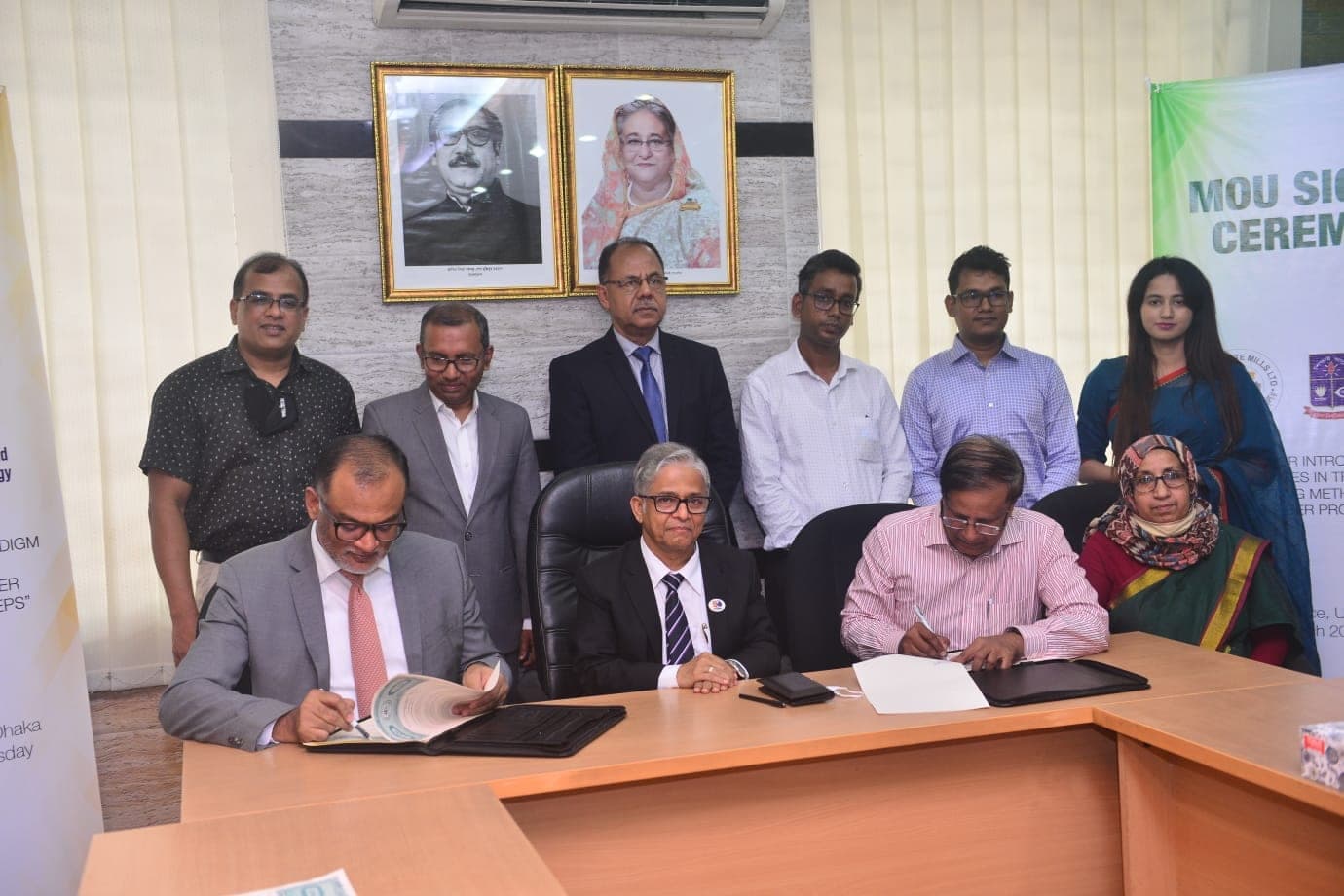
Janata Jute Mills and the University of Dhaka's Department of Biochemistry and Molecular Biology signed a one-year memorandum of understanding on jute cultivation research, funded by Akij Group. Its object is to make the crop commercially viable twice a year rather than once.
The Constraint Is Water
What fixes jute to a single season is retting — the soaking that separates fibre from stalk, and which needs water deep enough to submerge the crop. In practice that water exists only during the monsoon. The research therefore concentrates on changing the retting process itself and on reducing the dependence on natural water, so that the crop can be grown year-round, on any land, with little water. Akij Group's managing director has also described work on a new fibre-conditioning method for jute yarn.
What the Agreement Covers
- 01One-year research agreement, funded by Akij Group
- 02Partner: Department of Biochemistry and Molecular Biology, University of Dhaka
- 03Goal: commercially viable jute cultivation twice a year
- 04Focus: a changed retting process and less dependence on natural water
- 05Also under development: a new fibre-conditioning method for jute yarn
New Seed, Shared Varieties
The university has developed a new seed whose fibre quality is better than that of existing jute, and is working on varieties suited to coastal and saline soils. Its vice-chancellor has said that any new varieties resulting from the research will be made available to all, and that the university intends to pursue more industry-driven research through partnerships with businesses.
Reported by The Business Standard, 24 March 2022.